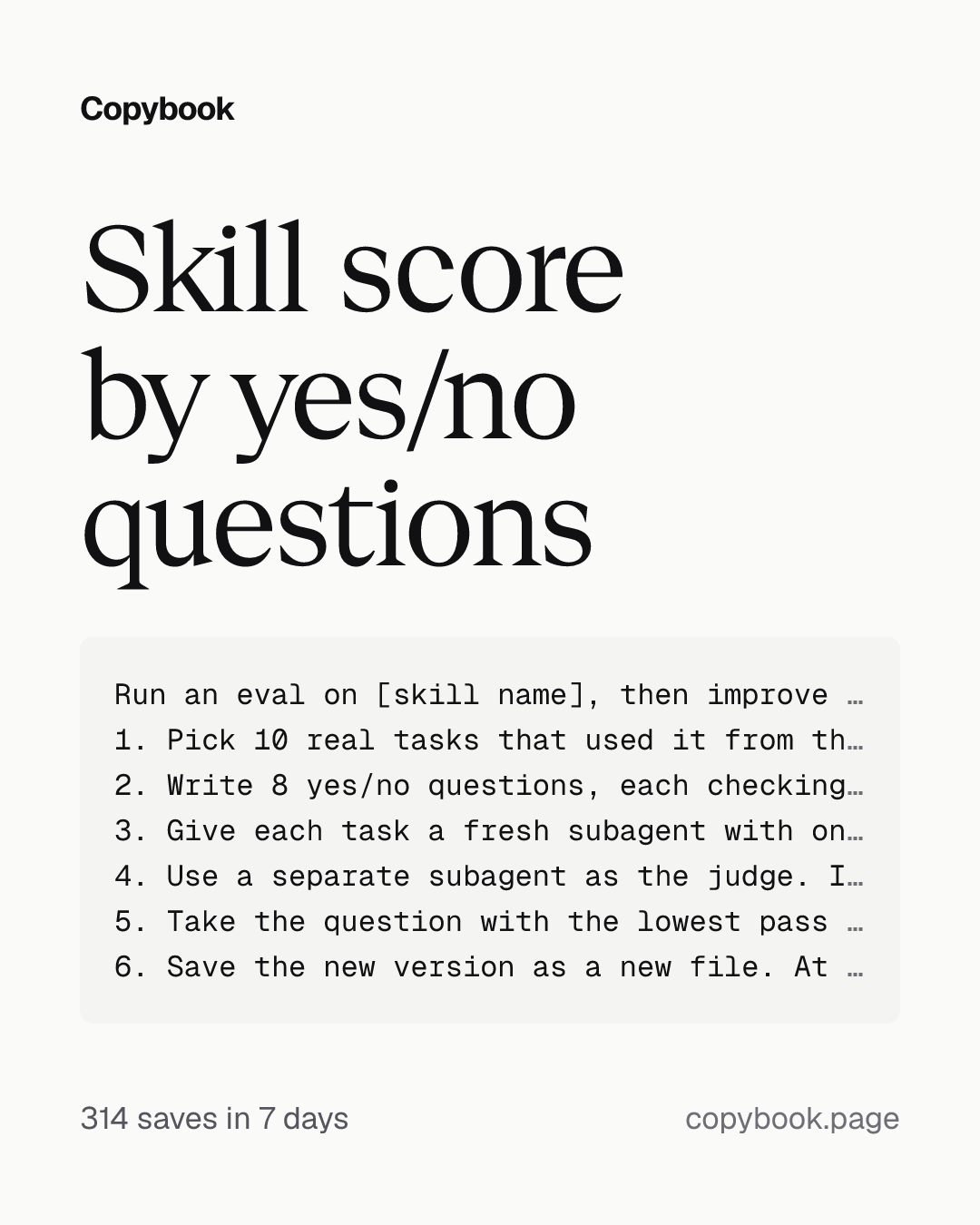
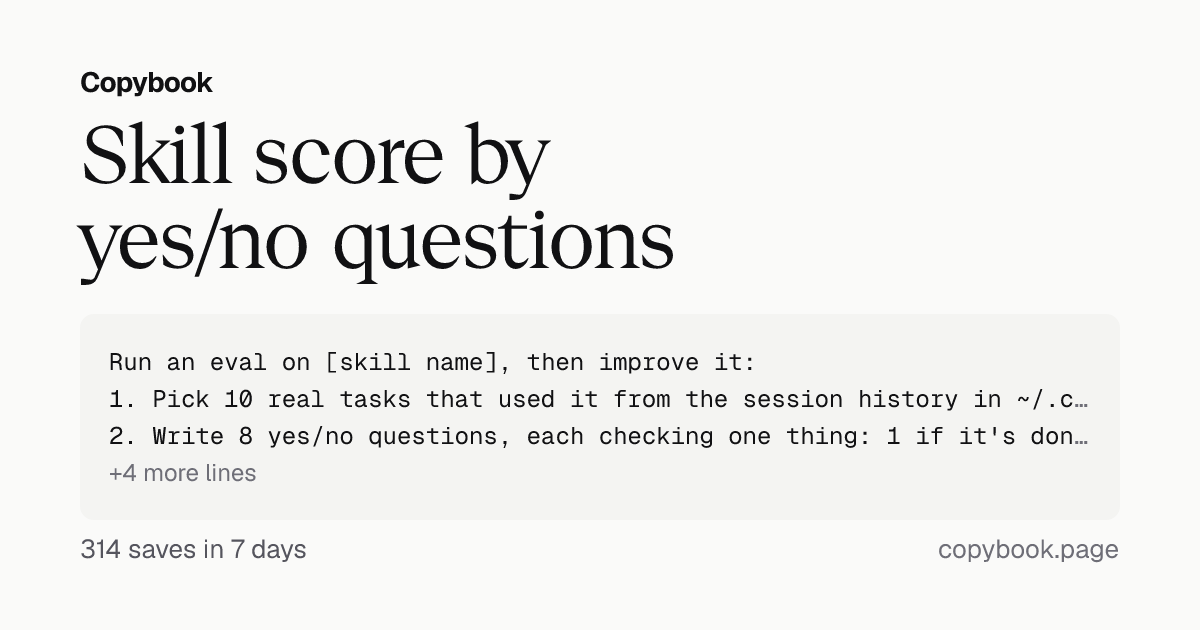
Skill score with yes/no questions
Did the skill edit help: 10 real tasks, 8 yes/no questions, a blind judge subagent; keep only a fix that raises the score.
314 saves on X, as of Posted
Run an eval on [skill name], then improve it:
1. Pick 10 real tasks that used it from the session history in ~/.claude/projects, and save the inputs as-is in evals/. If you can't find enough, ask me for more.
2. Write 8 yes/no questions, each checking one thing: 1 if it's done, 0 if it isn't. Show them to me first, and only start after I've edited them.
3. Give each task a fresh subagent with only the skill and that one input. For steps that would post or spend money, write down what they'd do without running them.
4. Use a separate subagent as the judge. It sees only the input and the output, and isn't told which version it's grading. I'll grade all 10 outputs first, and you continue only once the judge agrees with me 90% of the time.
5. Take the question with the lowest pass rate, write two fixes and run each. Keep the higher-scoring one only if that question passes on at least 2 more tasks and no other question drops.
6. Save the new version as a new file. At the end, give me the before-and-after scores and the lines you changed.
Next Send it to Opus 5.5 in Claude Code.
Mike Taylor, head of evals at Every and author of O’Reilly’s book on prompt engineering, says that if you can use scores to improve your own prompts and skills, you’re already in the top 5% of AI users.
Mike only grades with yes/no questions. Say you have a skill that writes tweets. Check what it writes, one item at a time: 1 point for each one it gets right, 0 for each miss. Have another AI answer those questions, but grade a batch yourself first and compare answers with it. If it agrees with you on 9 out of 10, hand the rest over. Then every time you change the skill, rerun the same tasks and compare the scores.
Send this to Opus 5.5 in Claude Code, with the skill you want to test in the brackets.
Share this tip